
NAPEO
You’ve probably read or heard that there’s a retirement savings gap in America. There’s a good chance you’ve even read that in the last month. Many states have introduced retirement plan mandates to address that gap. Here’s how PEOs can help.
States began considering retirement plan mandates approximately 15 years ago. Prior to the existence of state mandates, more than 50,000,000 private sector workers did not have access to a retirement plan (many of those workers employed by businesses with less than 100 employees). But people have always been free to set up their own IRA, so why the focus on workplace retirement plans?
States recognized that if individuals need to take all the steps to open an IRA on their own, most never will. But if it’s automated through payroll deduction participation rises enormously.
According to Ann Margaret Donnelly, senior sales executive within Marsh’s PEO retirement practice, auto-enrollment is one of the reasons why workplace plans have the best odds of success.
“The auto enrollment feature (aka opt-out) in a company’s 401(k) plan helps employees overcome procrastination due to perceived paperwork complexity and importantly it makes savings the default option. This results in compounding and wealth creation earlier than the former 401(k) opt-in method,” she explains.
Initially, there were concerns around whether employees would object to money coming out of their paychecks by default. However, “studies have shown that people do not notice a difference in their paycheck with 401(k) contributions up to 6% of pay despite the tendency to think that they cannot afford it,” Donnelly says.
THE STATES IN PLAY
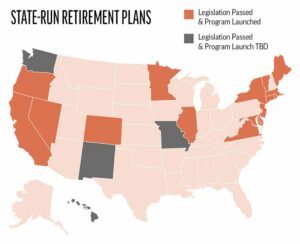
Today, the following states have either launched a program or passed legislation to do so: California, Colorado, Connecticut, Delaware, Hawaii, Illinois, Maine, Maryland, Massachusetts, Minnesota, Missouri, New Jersey, New Mexico, New York, Oregon, Rhode Island, Virginia and Washington.
The overwhelming majority of state programs are structured as auto-IRA programs. A few features they have in common include:
Auto-enrollment. Employees are automatically enrolled at a percentage determined by the state (generally 3%-5%). Employees can change their savings rate or opt out entirely.
After tax savings only, tax-free growth and withdrawals. The auto-IRA is essentially a Roth IRA offered by the state. IRA contribution limits ($7,500 in 2026, $8,600 for people age 50 and older) apply.
A small menu of investment options. These are primarily age-based funds.
Eligibility Requirements. States all have eligibility requirements and penalties for failure to comply, but the eligibility and penalties vary from state to state: employers in New Jersey and New York have a threshold of 10 employees; California goes all the way down to 1 employee.
As I mentioned earlier, state mandates were introduced to address the retirement savings gap, and they’ve been a success: over 1 million workers who weren’t saving for retirement are doing so today through a state-sponsored plan. That said, there are some drawbacks to consider.
Compliance falls on the employer. Many employers aren’t even aware that they’re subject to a state mandate, especially if their primarily location is in a state not subject to one.
Setup responsibility falls on the employer. As PEOs know, most employers do not have the capacity for additional tasks.
No benefits to employer other than ticking the box. There are no tax savings, limited investment options and low contribution ceilings for high earners.
Rafal Baransky of RBF Retirement Plan Advisors puts it this way, “unlike state-run retirement programs, a PEO-sponsored 401(k) offers plan design flexibility, higher contribution limits, broader investment options, and both pre-tax and Roth (after-tax) contribution features, whereas most state programs are limited to Roth-only. Participants also benefit from access to investment advisory support, which studies suggest may improve long-term returns by up to 3% annually.”
THE PEO ROLE
The opportunity for PEOs should be obvious. According to Ken Jewell, partner at The Baldwin Group, “We see more and more states adopting state run retirement plans, that quite frankly, are not as attractive as PEO MEPs and PEPs. We feel that this creates a huge opportunity for PEOs to further their growth.”
And with the tax credits available from SECURE 2.0, many businesses will experience little to no cost a tax benefit they leave on the table if they join the state-run plan.
If your PEO operates in any states affected by retirement plan mandate, businesses need your help. First, they need help understanding whether their business is subject to a mandate in any states they operate in. Second, they need help understanding their options; the state’s auto-IRA will be a suitable solution for some, but for others, the PEO’s plan is a more robust alternative with less hassle.
According to Jason Chepenik, senior vice president at One Digital, “For smaller companies, joining a PEO PEP plan can be much easier, as it provides immediate access to existing infrastructure and reduces administrative burden. The PEP model also accommodates outside advisors, creating a collaborative and flexible approach for employers adopting the plan.”
PEOs operating in these states have an opportunity to get ahead of the conversation before deadlines (or fines) hit. Many employers have no idea the mandate exists, let alone how to comply. State-sponsored IRAs have been successful in addressing the retirement savings gap and will work for many employers, but for employers who want a true employee benefit that attracts and retains talent, the PEO’s plan is the stronger conversation.
-
SHARE
- Copy to clipboard
RELATED ARTICLES

MEET CONGRESSWOMAN ERIN HOUCHIN
Voters in Indiana’s 9th Congressional district elected Congresswoman Erin Houchin to serve in the United States House of Representatives in November 2022. In doing so, Rep. Houchin became the first woman elected to Congress from her district. She also holds the distinction of being the only person elected to Congress who has worked for a PEO.Rep. Houchin spoke to PEO Insider about her decision to seek public office, her experience working for a PEO, and the policies she champions.
BY Chris Chaney
May 2023
NAPEO ADVOCACY DAY IS A HOME RUN
There's an energy around the PEO industry this year that's palpable. Nowhere is that more true than in Washington DC, where we are starting to make our mark as a strong contributor to the vitality and success of the backbone of the economy: small and mid-size businesses. We've got a great story to tell. Help us tell it.
BY THOM STOHLER
August 2023
THINK IT THROUGH: HOW RETURN-TO-OFFICE MANDATES MAY IMPACT EMPLOYEE ENGAGEMENT
As a result of the workforce evolution in recent years, remote, hybrid and onsite work has been redefined, and is a top-of-mind subject in daily conversations. Many companies and teams like ours at LandrumHR have an employee base geographically widespread throughout the U.S. In our case, this pre-dates the pandemic, but like these other companies we, too, are still evaluating the pros and cons to re-engaging teams physically onsite where and when possible, without causing disruption to workflow and requiring facilities (re)construct.
BY Gehan "G" Haridy-Ardanowski
February 2023
STAY INFORMED: RECENT LEGAL DEVELOPMENTS MAY IMPACT EMPLOYERS’ USE OF ARBITRATION IN EMPLOYMENT CLAIMS
Use of arbitration and class-action waiver agreements allows for the private resolution of employment claims on an individual basis. While arbitration is not a low-cost alternative, it can be a very strong hedge against runaway jury awards and swollen class-action damages.
BY STEPHEN CALVERT, ESQ.
May 2023