NAPEO
HIGH-TOUCH IN THE AGE OF HIGH-TECH: HOW PEOS CAN EMBRACE AI WITHOUT LOSING THEIR HUMANITY
March 2026
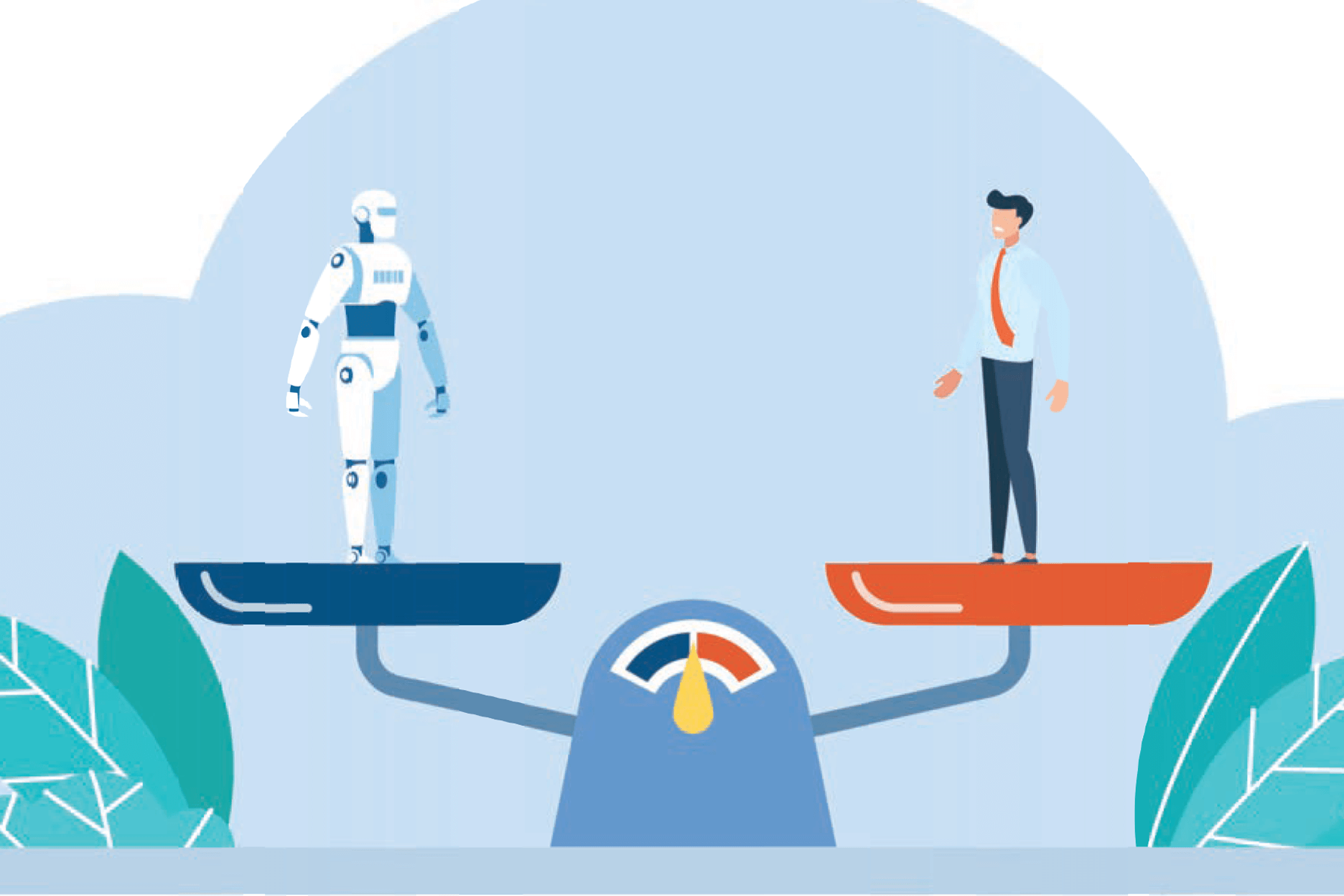
New and emerging human resources technologies have tremendous potential to create efficiencies and improve PEOs’ bottom lines. Automation, artificial intelligence and self-service platforms are transforming how HR work gets done and, in many cases, how clients engage with their PEOs.
When nearly every business interaction can be automated, streamlined or routed through a chatbot, it’s easy to assume that the future of HR consulting lies in technology alone. As AI becomes more powerful and more deeply embedded in HR operations, the question isn’t whether to use it. It’s unavoidable, for one thing, and it contributes significantly to automating routine tasks.
The challenge – and the opportunity – of AI is how to use it to support the people providing the customer service, rather than allowing it to replace that customer service.
HIGH-TOUCH MEANS HUMAN INTERACTIONS
In a historically high-touch industry like ours, PEOs must find a balance to ensure that high-tech solutions do the work they’re intended to do without substituting the human interactions that provide value to our clients.
That distinction is critical. AI can draft an email, but it can’t deliver empathy. It can summarize a policy, but it can’t coach a manager through a sensitive termination. It can analyze data, but it can’t sit across a table from a client who is heartbroken that a longtime employee has made a serious mistake.
When clients have relationships with dedicated consultants they can call directly, as they do at Axcet HR Solutions, context is clear and issues don’t bottleneck. Through those relationships, we understand our clients and their businesses and build trust.
We balance the technology that best supports our clients with human accessibility and oversight. That high-touch approach pays off: We hear repeatedly through our client surveys and unsolicited feedback that the relationships our clients and their employees have with their Axcet HR, payroll and safety consultants are the difference makers.
Human resources work is, by its very nature, a commitment to accessibility, responsiveness, listening and problem solving. That combination both protects the organizations we serve and gives them insights they can use to more effectively recruit, retain and manage their employees.
USING TECHNOLOGY TO CREATE MORE TIME FOR RELATIONSHIPS
As AI advances, it can be tempting to automate almost everything. But HR, after all, is human work. AI should make more room for that – not crowd it out.
An emphasis on relationships as co-employers sets us apart from non-PEO outsourcing solutions. The more effectively we leverage technology while maintaining high-touch relationships, the greater our competitive advantage.
The future of HR consulting is high tech, high touch and deeply human. For Axcet, automation is a capacity multiplier for our people, not a client-facing replacement for service. We use AI to automate workflows, repetitive tasks and low-value work, enabling our consultants to spend more time with clients to do what only humans can do: think critically, listen carefully and advise thoughtfully.
Responsible automation means combining technology and human oversight. We don’t ask clients to navigate bots or automated phone menus. Our company could automate our help desk and phones, but we don’t. When clients call, they speak with a human being who answers our phones, is trained to handle many of their common questions and can also direct them to assigned team members. The customer experience every PEO client expects and deserves is enabled by technology working behind the scenes so relationships remain front and center.
WHERE AI MAKES THE BIGGEST IMPACT
Because we want clients to experience AI’s positive benefits without giving up personal attention, we encourage our teams to embrace technology while maintaining high-touch relationships. Our IT team provides employees with AI training, and our leaders coach their teams on appropriate automation tools. Each employee decides how automation will free up time for more client interactions.
Internally, we share automation best practices for routine tasks, data processing, workflow tracking and applying AI within clients’ businesses. For example, we recently showcased how data mining statistics on employee queries and requests, along with average response times, helped a client apply predictive analytics and build better internal systems.
For our payroll team, variance and fraud detection, continuous compliance monitoring and predictive analytics are the most advantageous AI technologies. They significantly enhance efficiency, accuracy and strategic decision-making while reducing manual error and risk.
We also are exploring technology use to deliver added-value offerings to our benefit plans. For instance, AI has potential to help us provide clients with expanded communications so employees can fully understand their plan options.
As AI evolves, sentiment analysis, which can detect, interpret and classify emotions in text, will provide opportunities to better understand our clients and their employees’ feelings and allow us to proactively address their concerns for quick resolution. On the flip side, we can use AI sentiment analysis to identify engaged and happy clients most likely to participate in beta testing, refer us to their network or provide testimonials.
We simultaneously believe some HR functions should never be automated. AI will never fully understand the complexities of dealing with people; it cannot replace employee relations or respond effectively to sensitive workplace crises, which require discernment, empathy and experienced professionals. And, while AI tools can play a part in onboarding new clients, having our consultants handle this directly is an opportunity to build the relationship from the outset by asking the right questions, engaging more effectively and, eventually, setting us up to provide on-point recommendations and service.
Clients want to be seen, heard and supported by their PEOs. We also listen closely to our clients through regular check-ins. Often, our most robust and productive conversations come from no-tech industry roundtables and face-to-face meetings.
Lessons for the PEO Industry
- Let values determine where AI belongs
- Use automation tools responsibly
- Automate capacity, not client service
- Ensure trust with human oversight
- Reframe the PEO role from processor to partner
As a CPEO, Axcet HR Solutions uses AI and automation where they help us maintain the relationship-first culture that makes our company unique. In a technology-driven world, high-touch isn’t a liability, it’s a differentiator.
-
SHARE
- Copy to clipboard
RELATED ARTICLES
2023 DIGITAL TRENDS
Lorem ipsum is simply dummy text of the printing and typesetting industry. Lorem Ipsum has been the industry’s standard dummy text ever since the 1500s, when an unknown printer took a galley of type and scrambled it to make a type specimen book. It has survived not only five centuries, but also the leap into …
BY James Joyce
June/July 2023
AI IN CYBERSECURITY: THE GOOD, THE BAD AND BEING ON THE PRECIPICE OF A NEW ERA IN TECHNOLOGY
As you might expect with cybersecurity, battlelines are being drawn between the people creating AI solutions to help protect companies and the people making AI software that is designed to find vulnerabilities in areas designed to protect data; systems; financial and personal information; intellectual property (IP); and Industrial Internet of Things (IIoT) and other IoT devices.
BY Dwayne Smith
September 2023
ASK THE EXPERT: A Q&A WITH PAUL NASH OF BEAZLEY
Paul Nash is an employment practices liability (EPL) underwriter with Beazley. He is the EPL and Safeguard product leader for both the UK and US teams and was instrumental in developing the first SAM/SML policy issued by Beazley in 2006. He has more than 30 years of experience in the insurance. He recently spoke with Paul Hughes of Libertate Insurance about the state of the EPLI market, how he has seen the PEO industry evolve and more. PEO Insider captured their conversation.
BY PAUL HUGES
August 2023
WHY CYBERSECURITY SHOULD NOT BE THE SOLE RESPONSIBILITY OF THE IT DEPARTMENT
Cybersecurity is an essential aspect of business operations, which is why it cannot be viewed as the sole responsibility of the IT department. Cybersecurity threats evolve daily and organizations can best prepare and protect themselves by taking a shared responsibility to protect the company’s assets and data.
BY Jenna Marceau
March 2023ADVERTISEMENT