NAPEO
The U.S. labor market looks stable on the surface and is eroding underneath. Employment is still growing, but the growth is narrow, increasingly delivered through longer hours rather than more people, and disconnected from the parts of the economy generating output.
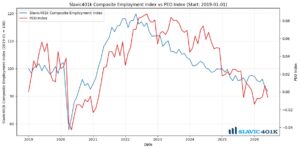
THE NATIONAL PICTURE
Payroll growth continues to decelerate, a trend that started back in 2022, when first pointed out by both of our proprietary labor market indicators (see above).
Recent payrolls weakness has likely been exacerbated by the estimated 100,000 jobs tied to World Cup activity. The giveback should be more visible in temporary help rather than leisure and hospitality payrolls and could be more pronounced in the August or September job reports.
Other recent labor market developments worth pointing out include:
There is a quality problem. Hiring narrowed after several months of improvement, with most private-sector gains coming from education and healthcare and little from anywhere else.
The unemployment rate has improved, but for the wrong reason. Participation fell alongside it. There are fewer people looking rather than more people hired.
Manufacturing payrolls rose while manufacturing hours worked fell, which means factories are spreading existing work rather than expanding production.
Construction is split, with data center and non-residential AI infrastructure work strong and residential homebuilding weak.
Altogether, the labor market can best be described as a “no hire, no fire” environment. Payroll growth is slowing, but initial jobless claims remain very low by historical standards, as outright layoffs continue to be limited.
Put simply, fewer businesses see a need to expand their staff, but managers are also reluctant to let go of existing talent.
This can be related to concerns about the growth trajectory of the economy, but other factors may also be at play, i.e., some companies may have learned to “do more with less.”
A slowdown in the labor market was to be expected after such a sharp post-COVID reacceleration in economic activity. It is also worth noting that the start of the labor market slowdown (according to our earlier-mentioned indicators) coincided loosely with the initial launch of ChatGPT, and in turn the current AI boom. If AI is delivering on all the productivity-boosting hype, then it would only be natural to see more companies require fewer workers to keep levels of output steady.
As for hard evidence of this, the productivity math is currently unflattering. Hours worked has risen more than 1% against roughly 2% GDP growth, implying productivity growth near 1% or less. The labor market has absorbed more hours than the output data justifies, which undercuts the productivity boom narrative many are leaning on.
To be fair, the productivity gains may be real but are still a long way off in terms of economic data. For example, during the internet and computer boom of the late 1990s, significant productivity growth didn’t show up in the economic data until the early 2000s.
Regardless, recent labor market dynamics still provide a lot of important and actionable takeaways for PEOs in the near-term.
WHAT LABOR TRENDS MEAN FOR PEOS
The hours-not-headcount substitution is the central issue, and it cuts both ways depending on how a book of business is priced.
Worksite employee (WSE) count is the primary revenue driver, and it is going nowhere. Same-store employment growth within existing clients has been the swing factor for Insperity and TriNet for two years, and a net -5% actual employment change among small firms is not a base that supports WSE expansion. Per-employee-per-month fee structures capture none of the upside from longer hours. Percent-of-payroll arrangements do better, since weekly earnings growth flows straight through, even with headcount flat. Anyone modeling PEO revenue off headline job growth alone will miss this.
Three things matter more than the headcount number:
Benefits economics. NFIB small business owner survey commentary is saturated with complaints about health insurance affordability, which is the single best PEO sales argument in existence. It is also the largest margin risk. PEOs carrying insurance cost risk in bundled plans have been repeatedly hurt by medical loss ratio surprises, and a client base under earnings pressure will resist passing those costs through.
The labor quality problem is a product opportunity. When 27% of owners surveyed by NFIB cite finding talent as their top challenge—and 85% of those hiring report unqualified applicants—recruiting, screening, and retention services become key differentiators, surpassing basic payroll administration.
Float income is a hedge. If the Fed tightens rather than eases, interest earned on client payroll funds rises even as WSE growth stalls. For payroll processors and PEOs alike, a hawkish Fed partially offsets a soft employment backdrop. That is an underappreciated buffer heading into a possible September hike.
The risk to watch is client attrition. Small business earnings are negative, insurance and input costs are compressing margins, and PEO contracts are a discretionary line item for a firm in trouble. Weak hiring hurts revenue; client failures hurt it far more.
The signal to watch is whether July’s jump in hiring plans holds into August and whether actual employment change moves from -5% toward zero. If it does, PEOs get organic WSE growth for the first time in a while. If it doesn’t, the plans get quietly withdrawn and the hours story continues.
-
SHARE
- Copy to clipboard
RELATED ARTICLES

CLIENT-LEVEL FINANCIAL ANALYSIS
If you asked someone in the PEO space what he or she thought of actuarial science a positive response might be reserve analyses or accruals. A negative response might be collateral calls or rate increases. Naturally, the varied reactions stem from whether there is positive or negative news coming from the work of the actuary. Yet, one of the most helpful projects an actuary can perform for a PEO, eliciting either positive and negative reactions, is a client-level financial analysis.
BY FRANK HUANG
June/July 2023
PROFITABILITY ABCs: IT IS AS EASY AS 1-2-3
The article provides some simple guidance for streamlining operations (thus reducing selling, general, and administrative (SGA) costs) and increasing gross profit contribution from their existing client base. For the purpose of this article, we are only exploring pricing strategies that affect client profitability and operating efficiency items that impact select SG&A cost categories. Business development and organic growth are excluded from this discussion.
BY Dan McHenry
June/July 2023
THE 5 Ws OF PEO GENERAL LEDGER RECONCILIATIONS
General ledger reconciliation is a key control to help maintain timely and accurate financial statements in any business. If you speak to accounting or finance professionals in the PEO industry, they will agree that general ledger balance sheet reconciliations are the most telling and critical tools in analyzing a PEO’s fiscal position. Failure to reconcile balance sheet accounts timely and accurately can lead to material losses to the PEO. Let’s explore the 5 W’s of PEO ledger reconciliations.
BY JEAN GOLDSTEIN
JUNE/JULY 2023
UTILIZING METRICS AS A PATH TO IMPROVING OPERATIONALLY OVER TIME
A company’s story is often written succinctly on its website, with details of the company’s history, its values, and its aspirations for the future. Internally, however, company leaders can capture a more telling story. Operational metrics, while often unique to each company, depict a different story.
BY Aaron Call
September 2023ADVERTISEMENT